Why Shade-Tolerant Grass Selection Matters for Palm Beach Estates
Warm-Season Turf Details That Property Owners & Estate Managers Need to Know
Key Takeaways:
- Maintaining shade-tolerant grass is a property value decision that boosts a property’s appearance and prestige
- St. Augustine and Zoysia are the best options for shaded Florida estates
- Cultivar specification is extremely underrated (For St. Augustine, choose Seville, Sapphire, Palmetto, or Bitter Blue. For Zoysia, choose Zeon or Geo.)
- Deep shade warrants reconsidering whether turf is the right solution at all
- Give your shaded sections (and entire property) the best care possible with Island Environmental
What a Shaded Lawn Tells the Market
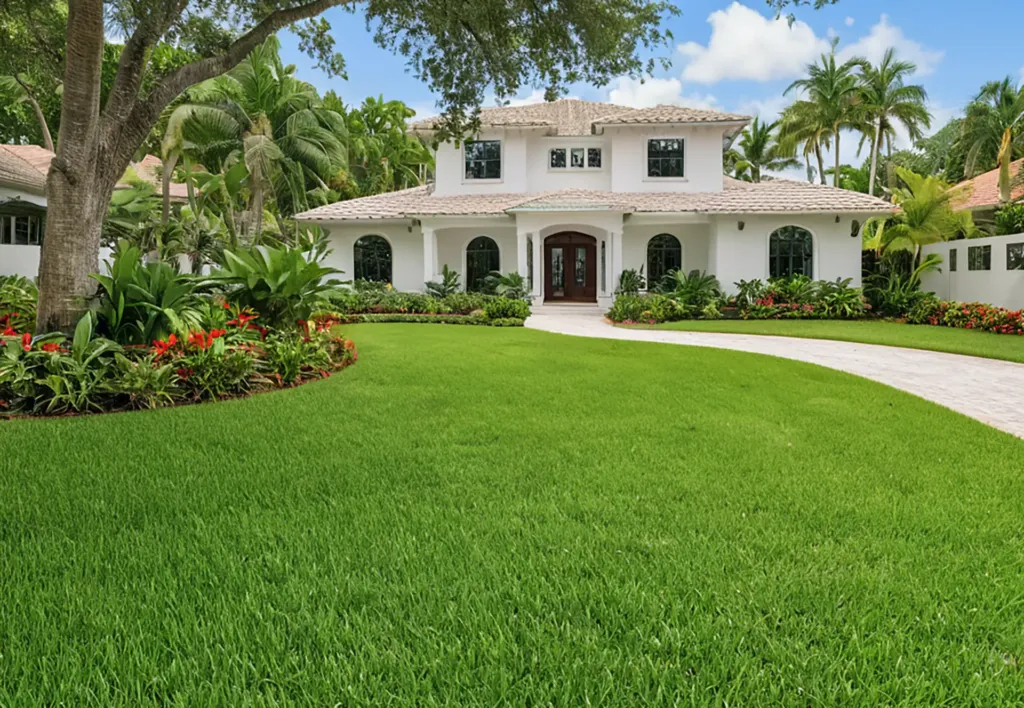
On a Palm Beach estate, the lawn is more than just landscaping. It’s part of the property’s architecture. A lush, uniform lawn showcases the home, enhances every tree and ornamental planting, and contributes directly to the elegance, prestige, and perceived value of the estate.
For estate owners, landscape architects, irrigation specialists, and the property managers who oversee high-value residential properties, every visible element of the grounds contributes to something larger.
Shaded areas are where that standard can break down. The bare patches under mature canopy trees, the thinning turf along north-facing walls, the persistent moss encroachment near dense plantings. These are signals that a property’s lawn care isn’t fully calibrated to its conditions. In a market where curb appeal carries real financial weight, that matters.
Understanding which grasses perform in shade and which ones fail is foundational knowledge for anyone responsible for maintaining a Palm Beach property. If overlooked, the landscape won’t meet the standard our market expects, preventing the landscape from achieving its true potential of beauty and refinement expected of a premier Palm Beach property.
The Impact of Shade on Florida Turf
Without sufficient light, grass can’t photosynthesize at the rate it needs to sustain healthy growth. Root systems stay shallow. The turf loses density. Weeds and moss, which tolerate low-light conditions far more effectively than turfgrasses do, move into the vacated space.
What began as a thin patch becomes a bare one, which multiplies into a maintenance problem that no amount of supplemental irrigation or fertilization can fully resolve. That’s because the limiting factor isn’t nutrition or water. It’s light.
Florida’s coastal environment adds complications that inland properties don’t face to the same degree. Palm Beach’s humidity keeps moisture locked into shaded soil for extended periods after rain or irrigation. That chronic dampness is an ideal environment for fungal disease, which spreads quickly through weakened, low-light turf and is both unsightly and difficult to fully eradicate once established.
Saline air and brackish irrigation water further narrow the range of grasses that hold up under these conditions. Tree roots in shaded zones compete for the same soil nutrients the grass above them depends on, quietly degrading turf health even when surface conditions look adequate.
All Shade Isn’t the Same
The right grass selection and management approach depends on what type of shade the area actually receives.
Dappled shade is filtered light moving through an elevated or open canopy throughout the day. It’s the most workable scenario. Grounds that feature mature palms or high-canopied trees often fall into this category.
Light levels shift across the ground as the sun moves, providing intermittent exposure that shade-tolerant varieties can use effectively. Well-chosen turf in dappled conditions can maintain the appearance expected of a Palm Beach property with proper management.
Partial shade describes areas receiving a few hours of direct sunlight alongside extended periods of indirect light. Results here are achievable with the right variety. However, the turf won’t respond to care the same as a fully exposed lawn, so that’s something a professional lawn care program accounts for.
Full shade occurs under dense canopy coverage, against structures that block direct light, or in orientations that receive minimal sun regardless of season. It requires species selected specifically for low-light performance.
Deep shade is where direct sun exposure falls below three hours daily. You may need to consider whether turfgrass is the appropriate ground treatment. For Palm Beach estates, the alternatives (native ground covers, tropical plantings, refined mulch beds, or hardscape features) can often deliver a more polished and sustainable result than turf that will struggle perpetually against its environment.
Warm-Season Grasses That Thrive in Shade
St. Augustine
St. Augustine has earned its position as the best shade-tolerant warm-season grass across the South. It can sustain itself on as little as three to four hours of direct sunlight daily. Also, its above-ground runners form a dense, weed-suppressing surface that looks lush and well-maintained.
Critically for coastal Palm Beach properties, it tolerates saline irrigation and brackish water exposure that would visibly damage most alternative grasses over time.
St. Augustine does require consistent irrigation and landscape management to maintain the density that reflects well on a property. It is also susceptible to lawn pest pressure, which makes routine professional monitoring and early intervention crucial.
Zoysia
Zoysia’s shade tolerance doesn’t extend as far as St. Augustine’s at the extreme low end, but in dappled and partial shade conditions, it frequently delivers a more refined visual result. That’s due to its finer texture, deeper green coloration, and a density that photographs and presents exceptionally well.
Its slower growth rate reduces mowing frequency, which has both practical and aesthetic implications for management. Zoysia does accumulate thatch over time, requiring periodic professional dethatching to maintain the surface quality and water penetration that keep it performing at the level a high-end property demands.
Why Cultivar Selection Matters
This is the variable that few consider, but it can lead to major differences.
Standard St. Augustine varieties are not developed with shade tolerance as a design priority. A property manager who specifies generic St. Augustine for a shaded area is not selecting for the conditions that area presents. The result, even with excellent maintenance, is typically mediocre turf that falls short of property standards.
The cultivars that actually deliver in reduced light are specific: Seville, Sapphire, Palmetto, and Bitter Blue for St. Augustine. These have been developed and refined specifically for low-light performance and produce better results than standard varieties in shaded conditions.
For Zoysia, Zeon and Geo are the recognized benchmark cultivars for shade performance in Florida. They consistently outperform other Zoysia varieties when light is limited.
Grasses to Avoid in Shaded Palm Beach Areas
Bermuda grass is widely used across Florida and performs exceptionally well in full sun. However, it’s the wrong grass for shaded areas. Its reputation for density, durability, and recovery is built entirely on its performance in direct sun. Under canopy cover, even moderate, Bermuda thins and eventually gives way to bare soil.
Any grass variety marketed primarily on heat tolerance, drought resistance, or general durability should be assumed to require full sun unless specifically documented otherwise. These characteristics are almost exclusively developed in high-light growing environments, and they don’t transfer to shaded conditions.
What Proper Shade Turf Management Looks Like
Selecting the right grass and cultivar establishes the foundation. Maintaining it at a standard appropriate to a Palm Beach property requires a management program specifically calibrated to shaded conditions.
Irrigation in shaded zones requires a different schedule than open turf. Shaded soil retains moisture significantly longer because it dries out more slowly without direct sun exposure. Running uniform irrigation across the entire property delivers too much water to shaded areas and sets up the chronic dampness that accelerates fungal disease and root rot. A professionally managed irrigation program accounts for this with zone-specific scheduling.
Mowing specifications for shaded turf differ from standard lawn cutting. Taller grass blades capture more of the available light and build the energy reserves the plant needs to maintain its density and color in low-light conditions. Mowing at the same height across all lawn areas is inadvertently weakening the shaded sections.
Fertilization in shaded areas requires precision rather than volume. Tree roots compete continuously for soil nutrients, which means shaded grass often runs deficient even in well-amended soil. A structured fertilization program compensates for that competition.
Annual aeration maintains the soil health that shaded turf depends on. Compaction develops progressively in shaded areas from tree root activity and reduced soil biology. Without regular aeration, water and fertilizer penetration decline, root development becomes restricted, and the surface appearance of the turf reflects those underlying conditions over time.
Strategic canopy management can meaningfully expand what’s possible in shaded areas. Mature trees give Palm Beach estates much of their character and are often the very reason shade-related turf issues develop. Selective elevation of lower limbs and professional thinning of dense overhead canopies increases light reaching the lawn without altering the established tree character of the property.
Island Environmental Serves Palm Beach With Precision
Evaluating a shaded area accurately means identifying the actual light conditions, soil profile, overhead tree species, irrigation history, and appropriate grass specification. This requires the kind of site-specific assessment that general advice can’t provide.
Island Environmental evaluates those conditions directly and builds a landscape management plan around what your yard actually needs. Our technicians handle aeration, soil amendments, fertilization programs, and more. We design our services specifically for the demands of turf in Florida’s climate.
Call Island Environmental to schedule your property assessment today. We provide high-quality lawn care and so much more for these communities: